
The UK energy sector is currently navigating one of its most turbulent periods in decades. Between the extreme volatility of global Brent crude prices and a domestic tax regime that seems to shift with every fiscal statement, the margin for error has never been thinner. For firms operating in the North Sea and beyond, the high tax burden and relentless regulatory pressure mean that financial success is no longer just about extraction efficiency, it is about fiscal precision.
In this high-stakes environment, many firms make the critical mistake of relying on generic financial advice. While a high-street firm might be excellent at managing a standard corporate portfolio, the energy industry operates on an entirely different plane of complexity. Achieving long-term stability requires a dedicated accountant oil and gas specialist who understands that in this sector, a decimal point in the wrong column doesn’t just mean a messy spreadsheet; it can mean millions in lost tax reliefs or a bruising encounter with HMRC.
This guide explores why general accounting frameworks consistently fall short in the energy sector and illustrates the specific risks firms face when they lack specialized financial guardianship.
The Unique Financial Complexity of the UK Oil & Gas Sector
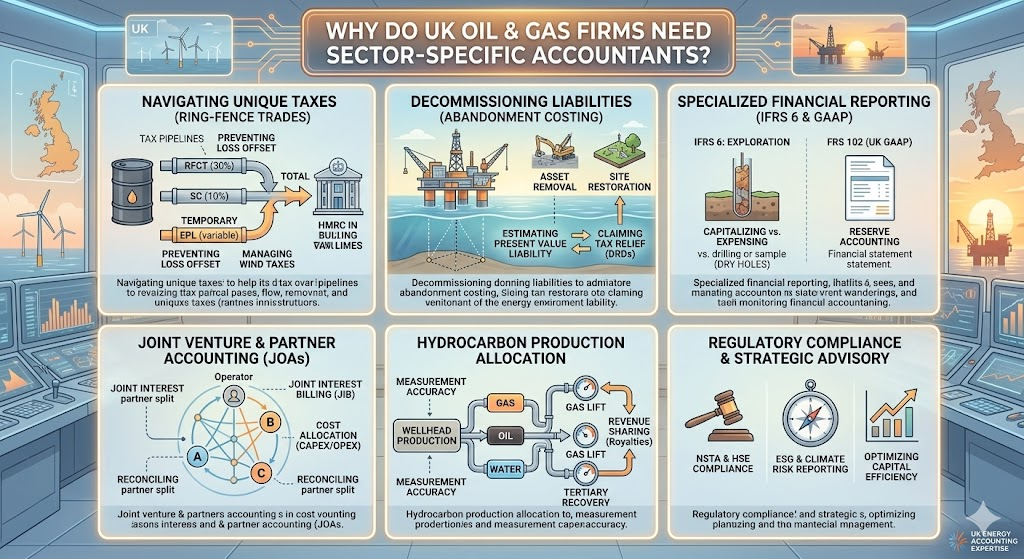
To understand why specialization is mandatory, one must first look at the sheer density of the UK’s energy fiscal regime. Unlike a standard UK business that pays a flat Corporation Tax rate, oil and gas companies navigate a “Ring Fence” system designed to ensure the state captures a significant portion of resource wealth.
Multi-Layered Tax Environment
The UK’s fiscal approach to oil and gas is often described as a “stack.” An accountant oil and gas specialist must manage three distinct layers of taxation:
- Ring Fence Corporation Tax (RFCT): Currently set at 30%, this prevents companies from offsetting losses from other diverse business activities against their oil and gas profits.
- Supplementary Charge (SC): An additional 10% tax on ring-fenced profits, further complicating the baseline liability.
- Energy Profits Levy (EPL): Frequently referred to as the “windfall tax,” this temporary levy was introduced to capture extraordinary profits. With its high rates and specific investment allowances, managing the EPL requires constant monitoring of legislative updates.
When these layers are stacked, the marginal tax rate can soar as high as 75%. Without a specialist to navigate the nuances of investment allowances and decommissioning reliefs, a firm’s effective tax rate can become unsustainable.
Industry Structure & Financial Complexity
The financial needs of a firm vary wildly depending on where they sit in the value chain.
- Upstream firms deal with high-risk exploration and massive capital outlays.
- Midstream focuses on the complex logistics of transport and storage.
- Downstream manages refining and retail.
Furthermore, the industry relies heavily on Joint Ventures (JVs). When multiple companies own a single field, the accounting isn’t just about internal numbers; it’s about “Joint Interest Billing” and ensuring that every partner is contributing their fair share of OpEx and CapEx while correctly reporting their portion of the “liftings” (the actual oil produced).
Specialised Accounting Treatments
Standard accounting principles (like IFRS or UK GAAP) have specific applications in oil and gas that are counter-intuitive to generalists. For instance, the treatment of Exploration vs. Production costs often choosing between the “Successful Efforts” method or the “Full Cost” method can radically alter a balance sheet. Additionally, Decommissioning Liabilities require firms to estimate the cost of removing platforms decades into the future, discounting those costs to present value. A generalist accountant rarely has the actuarial or sector-specific experience to calculate these multi-million-pound provisions accurately.
The Real Risks of Using Generalist Accountants
When a firm chooses a generalist over a specialist, they aren’t just saving on fees, they are inheriting a suite of invisible risks that usually manifest during an audit or a cash flow crisis.
Hidden Tax Overpayments
The UK tax code offers specific incentives for North Sea investment. A generalist might miss “First Year Allowance” opportunities or fail to optimize the “Investment Allowance” under the Energy Profits Levy. We often see firms overpaying by six figures simply because their accountant didn’t know how to “ring-fence” specific losses effectively.
Misclassification of Costs
Is an expenditure a repair (revenue) or an improvement (capital)? In oil and gas, getting this wrong affects your DD&A (Depletion, Depreciation, and Amortisation) schedules. Misclassification leads to skewed profit reporting, which can either lead to unexpected tax bills or, conversely, misleadingly high dividends that strip the company of necessary capital.
Joint Venture & Revenue Allocation Errors
In a JV, the “Operator” manages the site, but the “Non-Operators” pay the bills. If your accountant isn’t fluent in the Accounting Procedure of a Joint Operating Agreement (JOA), you risk audit disputes with partners. These disputes can freeze projects and destroy professional reputations within the tight-knit UK energy community.
Compliance & Audit Exposure
HMRC has dedicated teams for the Oil & Gas sector. They know exactly what “red flags” to look for. A generalist accountant may provide a standard tax return that lacks the necessary disclosures for the Supplementary Charge, virtually inviting an inquiry that could last years and result in heavy penalties.
Industry Pain Points Driving Demand for Specialists
The demand for a specialized accountant oil and gas expert isn’t driven by a desire for “fancy” accounting; it’s driven by the practical, day-to-day headaches of running an energy firm.
- Volatility Management: When oil prices drop from $100 to $70, a generalist looks at the past. A specialist looks at your break-even per barrel and helps you restructure your debt or hedge your positions before the cash flow dries up.
- ESG and Green Reporting: With the UK’s “Net Zero” targets, firms must now report on environmental liabilities and carbon footprints. Specialists integrate these ESG metrics into the financial reporting, ensuring compliance with the Task Force on Climate-related Financial Disclosures (TCFD).
- Project-Based Lifecycles: Oil projects have long lifecycles exploration, appraisal, development, production, and decommissioning. Each phase has its own tax and accounting rules. A specialist ensures the financial strategy evolves as the project moves from a “cash sink” (exploration) to a “cash cow” (production).
What Sector-Specific Accountants Do Differently?
If you were to peek inside the office of a specialist energy accountant, you would see a workflow that looks very different from a standard firm.
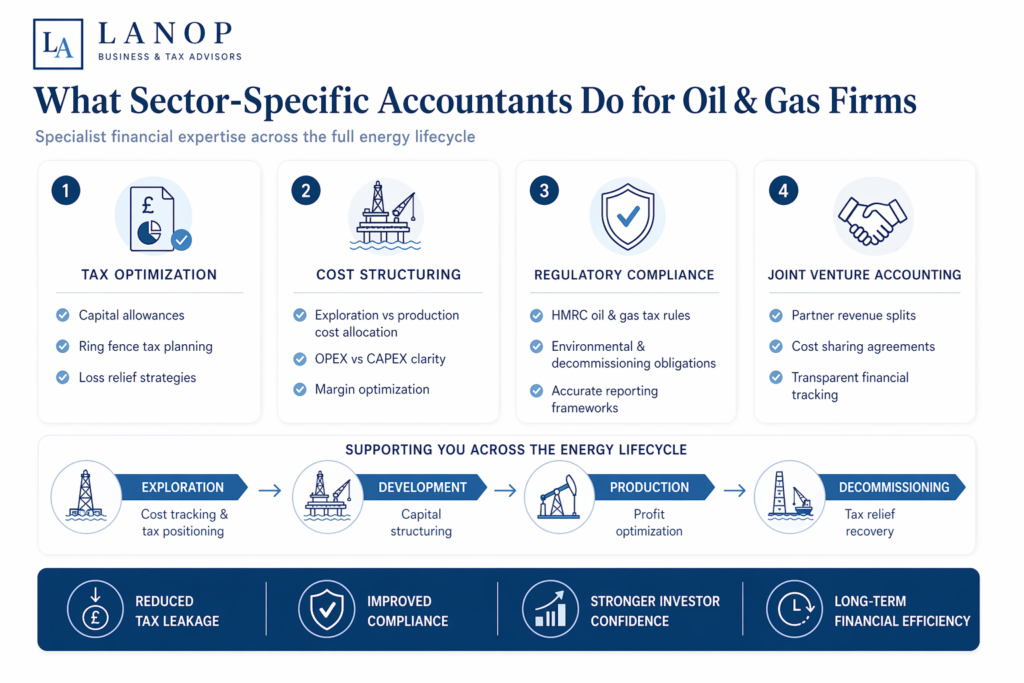
Advanced Tax Optimisation
Rather than just “filing returns,” specialists engage in Structural Planning. This might involve optimizing the group structure to ensure that decommissioning credits in one subsidiary can be utilized against profits in another, significantly lowering the overall tax burden.
Joint Venture Expertise
Specialists act as a bridge between partners. They ensure that “Cash Calls” are issued accurately and that the “Billing Statements” comply with the specific JOA. This transparency reduces friction and allows the technical teams to focus on drilling rather than debating invoices.
Proactive Scenario Modelling
A specialist doesn’t just provide a P&L statement. They provide a Sensitivity Analysis.
“If the Energy Profits Levy increases by 5%, or if Brent Crude drops by $10, here is exactly how your 2027 decommissioning fund will be impacted.”
This level of foresight is the difference between a firm that survives a market downturn and one that is forced into a fire sale.
Specialist vs General Accountant: A Practical Comparison
| Area | General Accountant | Sector-Specific Accountant |
| Industry Knowledge | High-level; treats oil like any other “product.” | Deep understanding of “lifting,” “farm-ins,” and “carried interests.” |
| Tax Efficiency | Standard Corporation Tax focus. | Optimised for RFCT, SC, and EPL. |
| Risk Management | Reactive (responds to issues). | Proactive (prevents issues via scenario modeling). |
| JV Handling | Likely to struggle with JV audits. | Expert at JOA compliance and partner reporting. |
| Strategic Insight | Minimal; focused on historical data. | High-value; focused on future-proofing and ROI. |
The Financial Impact: Cost vs Value
A common hesitation among smaller E&P (Exploration & Production) firms or service companies is the perceived cost of a specialist firm. However, this is a classic case of “penny wise, pound foolish.”
The Cost of Mistakes:
- Overpaid Tax: Failing to claim a 100% investment allowance on a £5m piece of equipment is a massive cash flow blow.
- Penalties: HMRC penalties for “careless” misstatements can range from 15% to 30% of the tax due.
- Opportunity Cost: Without accurate forecasting, you might pass on a lucrative “farm-in” opportunity because you didn’t realize your capital position was actually stronger than reported.
The Value Delivered:
A specialist accountant oil and gas expert protects your profit. By ensuring you never pay a penny more in tax than legally required and by streamlining your JV audits, the specialist usually pays for themselves many times over within the first fiscal year.
Common Misconceptions About Oil & Gas Accounting
Any accountant can handle it.
This is the most dangerous myth. The UK energy tax regime is so distinct that it is essentially a separate branch of law. Expecting a generalist to master it is like asking a GP to perform heart surgery. They understand the basics, but they lack the tools for the specialized task.
Specialists are too expensive.
In reality, the “cheaper” generalist is often the most expensive hire you’ll ever make. The money lost in inefficient tax structuring far outweighs the higher hourly rate of a specialist firm.
Accounting doesn’t affect operations.
In the North Sea, your “Field Life” is determined by economics. If your accounting is inaccurate, you might decommission a field too early (leaving oil in the ground) or too late (losing money on every barrel). Financial data is operational data.
When Should an Oil & Gas Firm Switch to a Specialist?
If you are experiencing any of the following, your current accounting setup is likely failing you:
- Your tax burden is rising, but your accountant can’t explain exactly why.
- You are entering a Joint Venture for the first time.
- Your financial reports take weeks to compile and lack “forward-looking” insights.
- You are facing an HMRC inquiry or a partner audit.
- You are planning to expand or divest assets.
Expansion is a major trigger. Moving from a single-asset company to a multi-asset group introduces complexities in “group relief” and “transfer pricing” that only a specialist can navigate without creating a compliance nightmare.
Frequently Asked Questions
What are the main taxes UK oil and gas companies need to plan for?
UK oil and gas companies face Corporation Tax (25%), Petroleum Revenue Tax (PRT) for older fields, and the Energy Profits Levy (EPL) an additional 35% windfall tax. Combined marginal rates can reach 75%–78% on North Sea production. Effective tax planning across capital allowances, investment reliefs, and deductions is critical to minimize liabilities while staying compliant with HMRC regulations.
How do capital allowances work specifically for oil and gas extraction activities?
Companies can claim 100% first-year allowances on qualifying expenditure including drilling equipment, platforms, pipelines, and infrastructure. Decommissioning costs also qualify for relief when incurred. Proper classification of capital vs operational expenditure and timing of claims significantly impacts cash flow. Specialist advisors ensure maximum allowances are claimed while meeting HMRC extractive industry requirements.
What is the Energy Profits Levy and how does it affect tax planning?
The Energy Profits Levy (EPL) is a 35% windfall tax on extraordinary profits from UK oil and gas extraction, effective until March 2028. Combined with Corporation Tax, total rates can exceed 75%. However, EPL includes an 80% investment allowance for qualifying capital expenditure, incentivizing UK production reinvestment. Tax planning focuses on maximizing investment allowances and structuring expenditure strategically.
How should oil and gas companies handle decommissioning cost provisions for tax purposes?
Decommissioning costs are tax-deductible when actually incurred, not when provisioned. Companies must forecast expenses decades ahead but can’t claim relief until payments are made. Tax planning involves timing decommissioning work to align with profitable periods and utilizing relief agreements with HMRC. Poor planning leaves companies with large bills and insufficient tax relief to offset costs.
What tax considerations apply when investing in UK renewable energy transition projects?
Oil and gas companies diversifying into offshore wind, hydrogen, or carbon capture face different tax treatments. Renewable projects may qualify for different capital allowances, green incentives, and R&D credits not available for fossil fuel extraction. Tax planning requires structuring these in separate entities to optimize reliefs while protecting oil and gas tax positions. Specialist advisors navigate the transition effectively.
Conclusion
The UK oil and gas industry is no place for financial amateurs. With the stakes involving multi-million-pound investments and a tax landscape that is arguably the most complex in the British economy, specialized oversight isn’t just a luxury.it’s a survival mechanism.
Lanop Business and Tax Advisors provides more than just a balance sheet; we provide a strategic roadmap for oil and gas companies navigating the UK’s challenging fiscal environment. We ensure that while your engineers focus on the technical challenges of the North Sea, your finances are being optimized, your risks are being mitigated, and your firm is positioned for long-term profitability.
Don’t leave your most critical assets in the hands of a generalist. Secure a partner who speaks the language of the energy sector.contact Lanop Business and Tax Advisors today.
Get specialist oil and gas tax planning from Lanop Business and Tax Advisors now.












Leave a Reply