
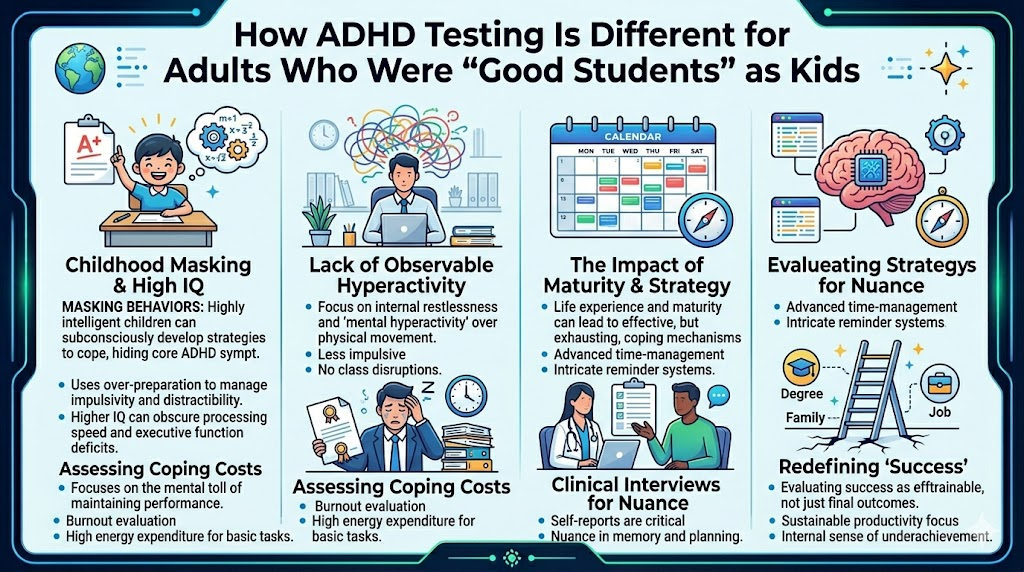
Many adults walk into a psychologist’s office carrying report cards full of A’s and B’s. They wonder if ADHD even applies to them. Their teachers praised their work. Their parents bragged about their grades. Yet now, as adults, they cannot finish a tax return, return a phone call, or sit through a meeting without their minds sprinting elsewhere.
This group presents a real puzzle for clinicians. Standard ADHD assessments lean heavily on childhood school records, teacher reports, and parental observations of struggle. A “good student” history can look like proof against ADHD. But the truth is more layered. Many of these adults compensated through high intelligence, fear of disappointing others, strict parents, small class sizes, or pure stubbornness. The ADHD was there. It just hid behind effort.
Testing for this group requires a different approach. The clinician must dig past the grades and look at the cost of those grades. A student who stayed up until 3 a.m. rewriting notes for a quiz worth 5% of their grade was not thriving. They were drowning in slow motion.
Take Sarah, a 34-year-old accountant who graduated with honors. Her childhood looked spotless on paper. During her adult evaluation, she described studying for 11 hours for a spelling test in fourth grade. She cried before every group project. She lost her homework folder twice a week but rewrote everything from memory the night before it was due. Her grades hid a child in constant panic.
How Childhood Evidence Is Reviewed When Grades Were Good
A skilled evaluator does not stop at a transcript. They ask questions that pull out the texture of childhood, not just the outcome. They want to know how a person studied, how long it took, and what fell apart when no one was watching.
The clinician may ask about bedroom organization, lost items, friendships, hyperfocus on hobbies, daydreaming during class, and time spent rereading paragraphs. They also ask about emotional regulation, which often gets ignored in school-focused screenings. A child who cried over small corrections or melted down when plans changed may have been showing ADHD signs that no teacher recorded.
Old report cards still hold value, but the comments matter more than the letters. Phrases like “talks too much,” “rushes through work,” “needs to apply herself,” “very bright but distracted,” and “messy desk” point to ADHD even when grades stayed strong. One patient, James, brought his fifth-grade report card to his assessment. The grades were A’s. The teacher wrote: “James knows the answers before I finish the question, but he never knows where his pencil is.” That single sentence told the clinician more than the GPA ever could.
Evaluators also look at the energy cost. A child who earned a B+ with two hours of homework is very different from a child who earned a B+ with six hours of homework, three meltdowns, and a parent sitting beside them the whole time. The result was identical. The internal experience was not.
Family interviews often reveal what school records miss. A mother might recall that her daughter could not start an assignment without help. A sibling might mention that the patient lost three retainers in one school year. These details rebuild the missing picture.
How Perfectionism Can Confuse ADHD Testing
Perfectionism complicates the testing process in ways that surprise many patients. High-achieving adults with ADHD often built rigid systems to survive school. They overprepared, double-checked everything, and tied their self-worth to flawless output. This creates a confusing test profile.
During an attention task, a perfectionist may score within the normal range because they are pushing themselves through the test with sheer adrenaline. They treat the assessment like a final exam. They may even outperform on short, structured tasks while still struggling with everyday life. A good clinician understands this gap and gives weight to real-world functioning, not just in-office performance.
A reliable adult ADHD test should measure attention across different conditions, including boring tasks, long tasks, and tasks without external pressure. Computer-based continuous performance tests, structured interviews, and validated rating scales like the DIVA-5, ASRS, or CAARS together give a fuller view. The conversation around the scores matters as much as the numbers. A score in the “normal” range does not rule out ADHD if the person’s life is falling apart behind the scenes.
Consider Maria, a 41-year-old lawyer. Her continuous performance test results looked nearly perfect. She concentrated hard during the 14-minute task. Her clinician then asked her how she pays her bills. Maria admitted she had not opened her mail in seven months. Her electricity had been shut off twice that year. She had three unfiled tax returns. The test result said one thing. Her life said another. The clinician trusted both data points and diagnosed her correctly.
Perfectionism also drives masking. Adults learn to script conversations, hide forgotten names with vague phrases, and apologize constantly to cover lateness. During interviews, they may downplay symptoms because admitting struggle feels like failure. Skilled evaluators ask the same question several ways. They ask about specific recent days, not general patterns. A question like “what did you eat for breakfast yesterday, and how long did it take you to leave the house?” reveals more than “do you have trouble in the mornings.”
Some pros of testing perfectionists include their willingness to participate fully, their thorough self-reporting once trust is built, and their ability to recall specific examples. Cons include their tendency to minimize symptoms, their fear of being seen as making excuses, and their habit of comparing themselves to people with more obvious impairments.
How ADHD Testing Separates Symptoms From Anxiety or Burnout
Many adults who finally seek evaluation arrive already exhausted. They may have a diagnosis of generalized anxiety, depression, or burnout. Their symptoms overlap heavily with ADHD. Trouble concentrating, restlessness, sleep problems, and irritability appear in all of these conditions. The evaluator must sort which symptom belongs to which cause.
The order of symptoms matters. ADHD shows up early in life, usually before age 12. Anxiety and burnout often arrive later as responses to stress, work demands, or unmanaged ADHD itself. A careful history can place each symptom on a timeline. If a 38-year-old cannot focus today but also could not focus in second grade, ADHD is likely present even if anxiety joined the picture later.
Burnout looks like ADHD but tends to lift after rest, vacation, or a job change. ADHD does not. A patient named Daniel took a three-month sabbatical after his evaluation began. His anxiety dropped. His sleep improved. His focus problems stayed the same. His messy car stayed messy. His missed appointments continued. The sabbatical helped his clinician separate burnout from the underlying ADHD that rest could not fix.
Anxiety creates focus problems through worry, racing thoughts, and avoidance. ADHD creates focus problems through neurological differences in attention regulation. The two can coexist, and in adults who masked through school, they usually do. Treating only the anxiety leaves the ADHD untouched and often makes the anxiety return.
Good testing includes mood and anxiety screeners alongside ADHD tools. The clinician then compares results across instruments and looks for patterns. They consider physical health, sleep apnea, thyroid issues, and medication side effects. They rule out trauma responses, which can mimic attention problems.
Real examples make this clearer. A 29-year-old teacher named Priya was told for years that she had anxiety. Treatment helped, but she still forgot to submit grades, missed parent meetings, and lost her keys daily. A second opinion included a full ADHD evaluation. She had both conditions. Once treated for ADHD as well, her anxiety dropped further because the daily chaos that fed it began to shrink.
The goal of testing this population is not to argue against the patient’s strengths. Good grades, professional success, and high intelligence are real. They simply do not rule out ADHD. They often mask it. A thorough evaluation honors the work it took to succeed while still naming the condition that made that work so much harder than it should have been.











Leave a Reply